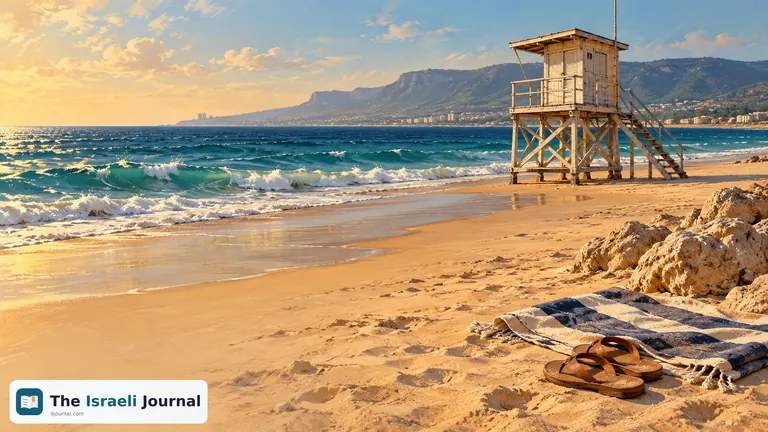
Tel Aviv Beaches: Follow the Flag While the Season's End Remains Unclear
October, pleasant sunshine, calm water and an almost empty beach. It sounds like the perfect time for a dip. Before entering, however, ask one question: is a lifeguard on duty? Even the seemingly simple question of when Tel Aviv's swimming season ends currently has two different answers.
On 1 October 2026, Maariv reported 10 October as the earliest stated season‑end date. Walla had reported on 14 April 2026 that the season would continue until 31 October. Two reports, two dates and no official announcement resolving them. The good news is that both dates are still ahead. Meanwhile, what determines whether to enter? The answer flies from a flagpole.
Four colors to remember
The beach flag system is simple and worth memorizing. White: swimming permitted. Red: swimming permitted with restrictions. Black: swimming prohibited. That is how a Knesset Research and Information Center document summarizes them. A less familiar fourth flag is purple. According to a June 2018 Interior Ministry document, it is a general jellyfish warning. It does not replace the sea‑condition flag or by itself instruct swimmers to leave.
The most important rule: the flag at the staffed station determines conditions, not a news story or app forecast. Once an official end date is published, a beach without a lifeguard is an unguarded beach. Calm‑looking water is not a lifeguard shift.
Water: How to know whether it is clean
Most swimmers do not ask a question worth asking: what is the water quality at my chosen beach? The Health Ministry explains that local authorities perform bacteriological sampling at designated beaches weekly during the swimming season, except at Dead Sea beaches. Check your beach's result, not "Tel Aviv beaches" in general, on the ministry's beach dashboard, beach by beach, on the day you go.
To find it, use the municipality's official names: Charles Clore Beach, Givat Aliya Beach, Hilton Beach, Gordon Beach, Jerusalem Beach and Northern HaTzuk Beach. The neighborhood nickname may not appear.
What happens after the season ends? There is currently no list of lifeguard stations operating in winter. Do not assume your regular beach will remain staffed or that it will close. Check.
Waves, jellyfish and promenade activity
A ynet forecast for 2 October described waves of about 60 to 110 centimeters, water around 28 degrees and winds of 15 to 35 kilometers per hour. Inviting? Perhaps. But a forecast is not a flag. The lifeguard at the station sees the sea up close and signals actual conditions.
Jellyfish reports on a community website included entries dated 29 September and 23 September, the latter concerning a central Tel Aviv beach. These are swimmer and surfer reports, not official warnings, and they age quickly. A swarm present yesterday may disappear tomorrow. The sign to look for in the morning is a purple flag at the station, if raised.
There is also a surprise on the promenade. According to the municipal page, upgrading Tel Baruch Promenade began on 10 June 2025 and was expected to last about seven months. The page was updated in July 2026, so if you see fencing there, know that it relates to works. It does not mean the water is polluted or the lifeguard station is closed.
Your morning in three steps
How do you head to the beach without guessing? Three small checks in the same order every day: the municipal beach page, the Health Ministry dashboard and the flag at the staffed station. Saturday does not change that order. Do not assume all stations share weekend hours. A time suitable for Gordon may not suit Northern HaTzuk.
Until the question of 10 or 31 October is settled, the rule is simple: enter according to the flag, not the headline. The two reports conflict. The flag, by contrast, always speaks one language.
Read also: Two Water Levels, Two Coastal Problems