Paper recycling is changing in Be'er Sheva: what goes in the blue containers and how to find them
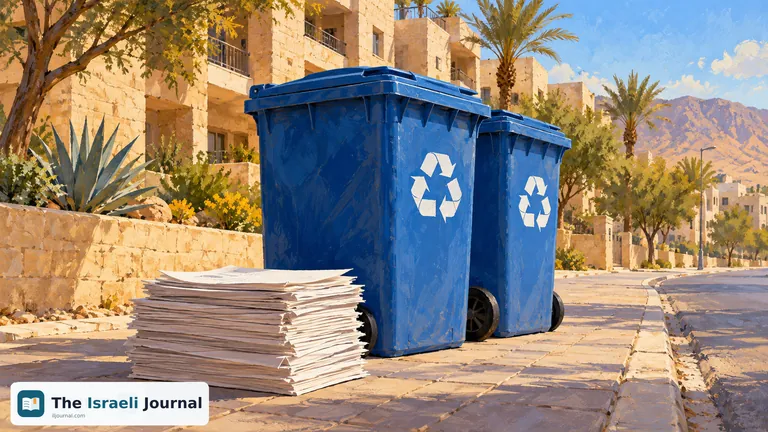
Be'er Sheva Municipality has replaced its paper bins with larger‑capacity blue collection containers and updated collection point locations. For residents planning to dispose of newspapers, notebooks or a pile of mail, the practical implication is simple: check where the nearest point is now and separate paper from cardboard before leaving home.
According to Be'er Sheva Net's report of 11 October, based on municipal information, the new containers are intended to improve collection and accessibility for residents. The move was also reported by the Rashuiot portal and Walla Sheva Darom. Alongside the replacement, the main instruction is clear: blue containers are for paper only. The delivery box that looks like it belongs in the pile needs to go to a cardboard container.
The container is larger, but does not accept every kind of dry waste
Walla Sheva Darom's publication of 13 October listed the materials intended for the containers: newspapers, letters and mail, notebooks, books and waste paper. These are the items to gather separately at home instead of mixing them with packaging and regular rubbish.
The same publication emphasizes that cardboard and household waste must not go in the containers. Be'er Sheva Net noted that separate collection facilities exist for cardboard. When clearing a cupboard or home office, start by sorting materials: a paper pile, a cardboard pile and items whose disposal route needs checking.
The blue color does not mean every dry object belongs inside. A book, a delivery box and a bag containing food scraps may leave the same room, but the municipal guidance quoted in the reports treats each differently. A major clear‑out is exactly the time to pause and sort before loading everything up.
Check the location before carrying the pile
According to the Rashuiot portal, the distribution of collection points was also updated during the replacement. Be'er Sheva Net directed residents to the location list on the municipality's website. A familiar location from the past is therefore not necessarily the best starting point for the next trip.
Before leaving with a large quantity, look for current recycling information on the municipal website and confirm the appropriate collection point. If information about a particular point is missing, contact the municipality and ask for the precise location of an active paper container near home. Give your street and nearest junction so the answer addresses the place where the service is actually needed.
A family disposing of a little paper at a time can combine the drop‑off with a walk or an already‑planned errand. Before taking out several full bags, however, make sure the location is clear. This advice does not require a special trip: it aims to prevent arriving at an old point and having to search for an alternative with paper already in hand.
Sort at home according to what you are actually discarding
Start with the mail pile. Letters and newspapers are among the items the municipality permits, according to the reports, but review documents before taking them out of the house. An invoice needed for an inquiry, a certificate that still needs keeping or a page containing personal information is not necessarily something to discard immediately just because it is made of paper.
Next, move on to notebooks and books no longer needed. If you want a book to be reused, look for a recipient before deciding to recycle it. That is the owner's choice, not a condition of using the container. Anyone choosing recycling should follow the published local instructions rather than relying on another city's lists.
Set aside a separate space for cardboard at home too. When enough accumulates, there is no need to reopen a bag already packed. Sorting beforehand is especially useful when several household members dispose of waste: explain that paper goes to the blue container and cardboard is collected separately instead of assuming everyone recognizes the distinction themselves.
If disposal is part of organizing a shared storage room, coordinate among residents who will gather the paper and who will handle the other items. Mark a temporary space at home or in the storeroom for each group and remove them separately. Before touching other people's notebooks, books or documents, also confirm that they really are intended for disposal. Agreeing in advance prevents belongings being kept from mixing with paper going to recycling, and allows the task to proceed gradually without loading the entire storeroom's contents onto one collection point.
What to do when there is a problem at the collection point
If a container has no room, choose another collection point or take the paper back until it can be deposited. Record the location and report the situation to the municipality. A useful inquiry includes a street, landmark and brief description, such as a full container or an opening that cannot be used.
Distinguish between a capacity problem and an access problem. A container may have space, but the route to it may be unsuitable for someone carrying a heavy pile. Before leaving, ask about an alternative location that is easier to reach. The reports describe the containers as more accessible, but that is not an individual description of every point and every walking route to it.
The replacement has been reported; its exact start date was not published
The mid‑October publications describe containers being replaced and locations updated, rather than merely a future intention. However, they do not give one date on which the change was completed in every neighborhood. Nor do they publish a full collection schedule for each point. Anyone needing information about a specific point must obtain it from the municipality.
According to the municipal information published by the Rashuiot portal, the aim is to collect more paper and encourage sorting. For residents, the next step is simple: check the collection point, remove cardboard and regular rubbish from the pile, and deposit only the paper types covered by the instructions. That makes it possible to use the renewed system without turning the blue container into another general waste bin.
Read also: Waste sorting and recycling in an apartment building