Battalion, Brigade, Division: A Short Guide to the Military Terms in Every News Bulletin
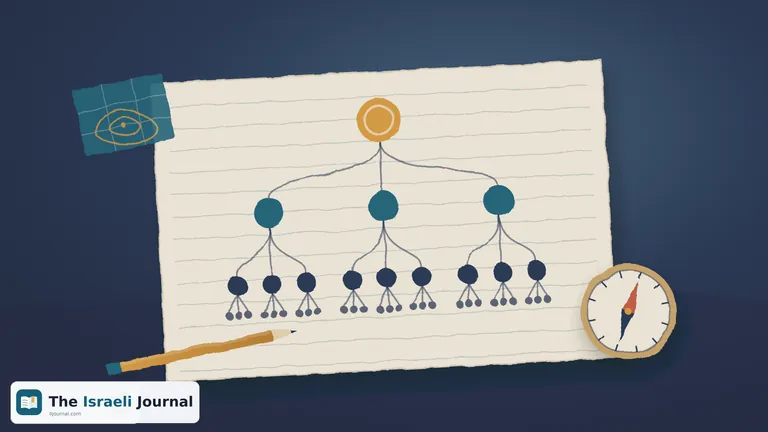
Almost every security report in Israel uses the same words: a battalion entered, a brigade withdrew, a division is operating in the sector. The terms are familiar to anyone who served, but they tell us less than we might think. A unit's name describes its place in the chain of command, not its troop count at a given moment. Remember that distinction whenever you hear how many forces entered an area.
The familiar ladder: From squad to division
In infantry units, the ladder begins with a squad, the small group led by a squad commander, known in Hebrew as a makh. Several squads form a platoon under a platoon commander, or mem‑mem, usually a junior officer. Several platoons form a company, headed by a company commander, or mem‑peh.
Above the company is the battalion, led by a battalion commander, or magad, usually a lieutenant colonel. The battalion appears in headlines most often because it is large enough to carry out a complete mission in a sector and small enough to identify by name. Several battalions form a brigade, led by a brigade commander, or mahat, holding the rank of colonel. Several brigades form a division, commanded by a brigadier general.
This order is fairly consistent, which makes it useful: when a report says a battalion commander was wounded, it clearly refers to the commander of an entire unit, not a small team. When a division moves between sectors, it clearly means a broad movement involving headquarters, supporting units and logistics, rather than a small force moving between outposts.
How many soldiers are in a battalion? It depends when and where
This is where confusion begins. Many armies commonly describe a platoon as a few dozen soldiers, a company as around a hundred or more, a battalion in the hundreds, a brigade in the thousands and a division as larger still. These are general orders of magnitude, not a rule. A battalion in prolonged combat, a partially mobilized reserve battalion and a battalion in training may differ greatly even if their names on paper are identical.
The service branch also changes the picture. In armor, the basic unit is the tank crew, with four crew members in a Merkava tank. A tank company is measured primarily in vehicles rather than personnel, so comparing it with an infantry company by troop count misses the point. In artillery, the company‑equivalent unit is called a battery. In the air force, the familiar unit is the squadron; in the navy, organization centers on vessels, and many units are called flotillas.
Anyone wanting to look beyond the IDF and compare other armies' structures can find a detailed explanation of military unit names and sizes on Military Ledger. For present purposes, remember that the name answers "who is above whom," not "how many."
IDF brigades and divisions: Identity and territory
Many IDF brigades have distinct identities, so readers know them by name: Golani, Givati, the Paratroopers, Kfir and Nahal are regular infantry brigades, alongside armored brigades and numerous reserve brigades. The name indicates tradition and force type, but not the precise composition at every moment.
In the field, a brigade often operates as a brigade combat team. This means units from other branches, such as armor, combat engineering or artillery, are attached according to the mission. The same brigade can therefore operate with very different compositions in different operations. A report that "the brigade entered" primarily identifies who commands, rather than how many forces are moving.
IDF divisions broadly fall into two types. Territorial divisions are responsible for a fixed sector and its defense; others are intended for maneuver and moving forces between theaters. The Gaza Division, for example, is a territorial division responsible for a defined sector. Above the divisions are the territorial commands, Northern, Central and Southern, alongside Home Front Command, which is responsible for civilian protection.
How to read force reports without getting lost in details
The first rule is to ask about the mission. When a report mentions "two brigades" in a sector, what matters is what they are doing: defense, a raid, maneuver or holding territory. The same brigade count can describe a major effort or a routine deployment.
The second rule is to check who is speaking and when. An IDF Spokesperson's statement, a military analyst's assessment and a quotation from foreign media use similar words, but do not always refer to the same moment. A report accurate in the morning may be outdated by evening after forces rotate.
The third rule is to notice qualifications. Phrases such as "forces from the brigade" or "division troops" describe part of the unit, not all of it. In reporting on reservists, the gap between a unit as commonly understood and those actually mobilized in a particular rotation can be substantial.
A short glossary for the next report
Squad: the small infantry group led by a squad commander. Platoon: several squads under a platoon commander. Company: several platoons under a company commander; in artillery, a battery. Battalion: several companies and supporting units under a lieutenant colonel. Brigade: several battalions under a colonel, sometimes operating as a brigade combat team. Division: several brigades under a brigadier general, either territorial or maneuver. Command: the territorial level above divisions, led by a major general.
With this glossary, it is easier to follow security news without jumping to conclusions. A battalion is not a number, a brigade is not a fixed quantity and a division is first of all a headquarters with responsibilities. Actual figures, when published at all, generally arrive later and in a different context.