Ashdod's waste collection changed in October: more trucks, two sectors and service monitoring
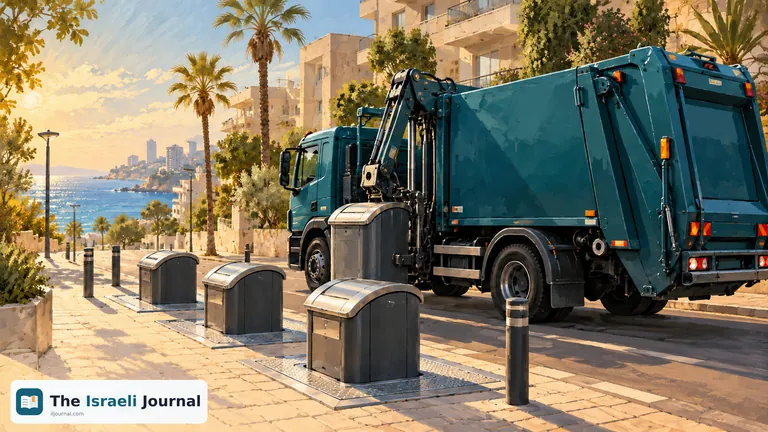
Ashdod's new waste collection system began operating on 1 October 2026. According to the municipal announcement published by Kan Darom and Ashdod Online, the compactor truck fleet increased from 28 to 40, and services for underground waste containers were reinforced. For residents, the change is intended to be felt in services near home: collection, washing and bin maintenance, alongside a system monitoring the work.
The fleet has gained 12 trucks, an increase of about 43 percent over the previous number. This measures the operational capacity the municipality added, not an improvement already felt on every street. Understanding what actually changed also requires looking at service frequency, the condition of containers and how local faults are handled.
How collection work is being reorganized
According to the published details, three collection companies operate in two operational sectors instead of one sector covering the whole city. The municipality presents this division as a way to improve backup and continuity between companies. Two trucks per district were planned for underground containers instead of one, with additional haulage rounds for crane trucks. Extra equipment is also intended for compactors in high‑rise buildings.
The significance of this division is tested at each address. A building with a compactor, a complex with underground containers and a street with wheeled bins do not necessarily receive the same service. When asking what has changed near home, specify the type of installation instead of simply asking when a truck comes.
A building committee collecting requests from several residents can also distinguish the problems: a container not emptied, a damaged lid, litter around it or a compactor needing attention. This is more than a bureaucratic distinction. A precise description makes it possible to seek a response to the actual problem instead of assuming another collection round will resolve every nuisance.
Daytime collection and maintenance beyond emptying bins
The details of Ashdod's new waste collection system state that waste containers will be emptied every other day and collection will take place during daylight hours, except on holiday eves. The municipality also said the new trucks are quieter. The publication does not include a full street schedule, so it does not establish a particular day for every building without a specific inquiry.
The system also includes a truck for washing underground containers and a requirement for collection companies to carry out four washing rounds a year for underground containers and wheeled bins. According to the report, it also includes treatment inside underground containers to reduce nuisances. These maintenance operations differ from routine collection, and it is important not to confuse them when checking whether the announced service was delivered.
A container that was emptied but remains dirty does not necessarily indicate a missed collection; it may point to a different need. Conversely, a washed waste area does not prove that capacity is sufficient until the next round. Residents or building committees should document exactly what remains after service so it is possible to assess whether collection, cleaning or repair is needed.
Smart monitoring is not an already‑proven result
Reports about the system describe tools for monitoring truck movements and work performed. The municipality's stated aim is to track service and adjust operations. Alongside the fleet and new division of work, this is another operational layer intended to help identify problems. At launch, there are not yet long‑term performance figures showing how much nuisances have declined.
The change can be assessed without waiting for a citywide figure. At a particular building, residents can record when a container filled up, when it was emptied and whether a problem remained. A short sequence of dates and photographs is more useful than a general impression that things are always bad or that everything is already resolved. There is no need to photograph people or personal details to document a waste container's condition.
A fair comparison also requires comparing similar situations. An exceptional load after a building event does not necessarily reflect the quality of the regular collection round. By contrast, repeated accumulation in the same spot may justify examining how well the service matches use of the container. Documentation is intended to clarify the need, not decide in advance who is responsible for a fault.
No change to residents' charges was published as part of this update. Expanding the collection fleet is not, by itself, evidence of an increase in municipal property tax or a new fee.
What residents and building committees should do now
Check the collection arrangements for the address and keep the information accessible to residents. If the building's routine changes, a short, precise notice is more useful than circulating an assumed schedule for the whole neighborhood. When information is unclear, contact the municipality and provide the address, container type and specific question that needs resolving.
When reporting a nuisance, include a clear location and factual description: is the container full, is access blocked, does the lid fail to close or is there litter beside it? Keep any reference number received so the same case can be followed up. If the problem recurs, add the new date instead of resending a description that does not explain the sequence.
In an apartment building, also make sure access to the installation is unobstructed and maintenance staff know who is coordinating inquiries with the municipality. There is no need to change all waste arrangements just because a new fleet has been announced. Start with local information, check delivery and address what is actually causing trouble.
The expanded system is a significant municipal change, but its everyday test remains close to home: is the container emptied on time, is its surroundings maintained, and does a fault receive a response? These are the things residents should check in the first weeks as the larger truck fleet moves from a plan into routine service.
Read also: Recycling in an apartment building: what to know beyond the orange bin