Gasoline Falls to NIS 7.35 as November Begins, Then Rises Again on 5 November
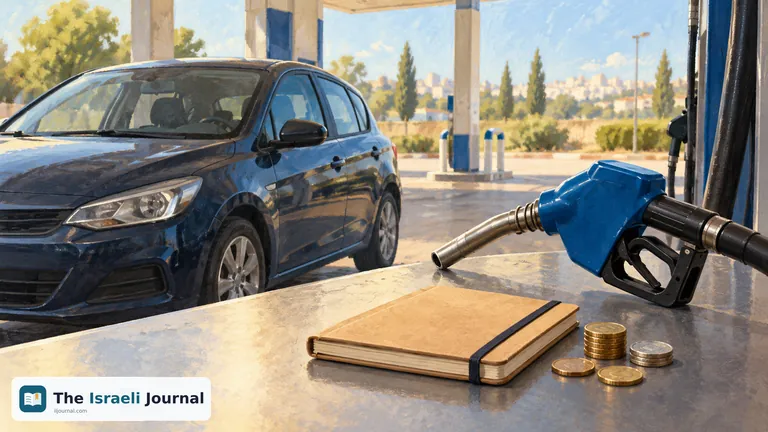
The maximum price of a liter of self‑service 95‑octane gasoline will fall to NIS 7.35, including VAT, at midnight between 31 October and 1 November 2026. That is NIS 0.42 below the previous cap of NIS 7.77. Buying 50 liters will therefore cost NIS 21 less. The new price, however, is not a guarantee of a fixed cost throughout the month.
According to Calcalist's updated report of 30 October, an order retaining a NIS 0.50 excise reduction has been signed, putting the price at NIS 7.85 from 5 November. Globes also reported the signature and the same price. The opening reduction therefore applies only to the month's first four days. The subsequent rate differs from the NIS 8.35 scenario in the original announcement, before reporting on the order.
What filling up will cost at the start of the month
At the new ceiling, buying 40 liters will cost NIS 294 instead of NIS 310.80, a saving of NIS 16.80. For 50 liters, the bill will be NIS 367.50 instead of NIS 388.50. For 60 liters, it will be NIS 441 instead of NIS 466.20, a difference of NIS 25.20.
These calculations use the amount of fuel actually purchased, rather than the tank capacity listed in the vehicle specifications. If fuel remains in the tank, the next purchase may be smaller. When comparing two receipts, look at the number of liters and the price per liter, rather than only the total paid on each visit.
The word "maximum" matters too. The regulated price is a ceiling, so these calculations do not determine what every station will charge or the price after an individual discount. If you were already paying less than the previous ceiling, your saving compared with that purchase will not necessarily be NIS 0.42 per liter.
Full service and Eilat need separate calculations
The ministry says the full‑service surcharge remains NIS 0.26 per liter, including VAT. Added to the new ceiling, that gives NIS 7.61 per liter. Buying 50 liters will cost NIS 380.50, compared with NIS 367.50 for self‑service. The difference between the two services is NIS 13 for the same quantity.
In Eilat, where the published rate excludes VAT, the self‑service ceiling will be NIS 6.23 per liter, down NIS 0.35. The full‑service surcharge remains NIS 0.22, giving a calculated full‑service price of NIS 6.45. At those ceilings, 50 liters will cost NIS 311.50 or NIS 322.50, respectively.
A useful comparison involves the same product and service. An Eilat price is not a basis for calculating costs at a station outside the city, and a self‑service rate is not the full‑service price. Before authorizing a purchase, check the amount displayed at the pump and the selected service, especially if you are relying on a headline price.
Why the price falls, then rises within the same week
According to Calcalist's 29 October report on ministry figures, international gasoline prices fell by about 13.2%, while the dollar strengthened by about 2% against the shekel, offsetting part of the effect. In the domestic price calculation, the gasoline component contributed a NIS 0.36 reduction per liter, and a NIS 0.06 VAT reduction completed the overall decrease.
That explains why a change in one international price alone cannot establish the pump price. Here, the product price, exchange rate and tax component worked together. The excise change adds another transition within the month, beyond the adjustment set for its first day. A lower opening price does not mean the same rate applies later. Reports differ on when the order expires, so the November price does not establish the rate for December.
At NIS 7.85, buying 50 liters will cost NIS 392.50. That is NIS 25 more than the same quantity during the first four days of November, and NIS 4 more than at the previous NIS 7.77 ceiling. This comparison concerns self‑service outside Eilat; the Eilat and full‑service rates shown earlier apply only to the start of the month.
A monthly budget needs more than one price
For a household buying 150 liters a month, purchasing the entire quantity at NIS 7.35 would cost NIS 1,102.50. At NIS 7.77, the same quantity costs NIS 1,165.50. The NIS 63 difference compares rates only: it is not a forecast of monthly savings, because there is no certainty that every liter will be purchased at the lower price.
Another scenario illustrates the point. If 50 liters are bought at NIS 7.35 and another 100 liters at NIS 7.85, the total is NIS 1,152.50. Compared with buying the entire quantity at NIS 7.77, the difference is just NIS 13. This arithmetic example shows why the purchase date matters. It is neither a recommendation to buy a particular quantity nor a figure for average consumption.
A useful way to track the budget is to record the date, number of liters, unit price and total at each purchase. This separates changes caused by fuel prices from changes caused by driving more. A household running two vehicles can collect the receipts together without assuming both consume the same amount.
What to check before the next journey
At the start of November, check that the displayed pump price corresponds to the chosen gasoline and service. Ahead of 5 November, check the latest Energy Ministry update instead of relying on a screenshot of the early‑month price. Anyone planning a longer trip can use the volume calculations to estimate the expense, applying the rate for the date on which the fuel will be purchased.
The amount to budget is the price on the purchase date multiplied by the quantity you need. The initial reduction has been set, and reports on the order point to a partial increase later that week. Distinguishing the two dates makes the expected expense clearer without turning savings on one purchase into a promise for the whole month.