Invasive Ant Identified in Haifa's Neve Sha'anan: What to Record and Why Suspect Plants Should Stay Put
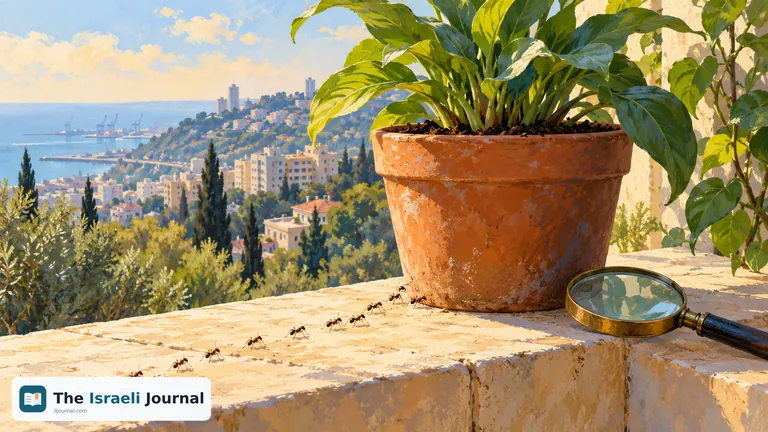
The big‑headed ant has been identified in Israel for the first time in Haifa's Neve Sha'anan neighborhood, following residents' reports. The Environmental Protection Ministry announced the discovery on 29 October and asked the public to help map its spread. Residents are being asked to take practical steps: photograph suspected sightings, give a location, and avoid moving pots, soil, seedlings and garden cuttings from areas suspected of infestation.
According to Davar's report on the ministry announcement, information can be sent to [email protected]. The ministry stresses that the species does not pose a human health danger but can damage nature and agriculture. There is therefore no need to turn every trail of garden ants into an emergency; professional identification and preventing movement to another location matter.
What was found in Haifa and what is still being checked
Reports leading to identification came mainly from Givat Hashavshevet and nearby streets in Neve Sha'anan. Reports published on 29 October say sightings in the Hadar neighborhood are also being investigated. A location where identification has been confirmed should be distinguished from one where a report still requires examination.
The announcement is not a complete map of every garden and street occupied by the ant. Nor does it show that every plant pot in the neighborhood is infested. For residents, the useful question concerns their particular location: which entrance, which part of the garden, and whether ants are moving around containers or soil intended for transfer.
The mapping involves the Environmental Protection Ministry, Haifa Municipality, the Israel Nature and Parks Authority and Tel Aviv University. A public report gives them a point to investigate; it does not replace that investigation. Describe precisely what you saw without identifying the species with certainty from an online picture.
Why moving a plant pot can be part of the story
The species' scientific name is Pheidole megacephala, and it originates in Africa. According to the ministry's explanation reported by ynet, colonies can have several queens and networks of cooperating nests. Its ability to establish multiple sites is one reason authorities want to detect its spread early.
The ministry identifies the movement of infested pots, seedlings, soil and cuttings as a possible route of spread. This does not mean every plant delivery is dangerous. It explains why an ordinary activity, such as giving a neighbor a plant or moving one to another apartment, deserves a check when ants are suspected at the source.
If you notice suspicious activity in a pot you planned to give away, pause the transfer and seek instructions. A gardener or residents' committee arranging garden work can also record the location and ask how it should be handled before moving material from it. The published instruction is to prevent suspect material from spreading, rather than taking it elsewhere on your own initiative.
The environmental harm is not limited to ants entering a kitchen. According to Arutz Sheva's report on the ministry announcement, the species can displace native ants, harm small animals and protect plant‑damaging aphids. These are risks associated with its establishment, rather than descriptions of damage already measured in every Haifa garden.
What to photograph and how to make a useful report
The ministry describes signs that may raise suspicion: many ants moving quickly in dense trails, with small ants alongside others with unusually large heads. The ants are brown and may also appear on trees. As the Kolbo report emphasizes, Israel has native species with similar characteristics, so general appearance cannot establish a definite identification.
For a report, try to photograph the ants clearly and show their surroundings. A close picture can help show their appearance, while a wider image can locate the activity relative to a pot, path or tree. There is no need to move soil or a plant to illustrate the sighting; begin with documentation where it occurred.
Include an address or location as precise as possible. It is useful to say when you noticed the activity, whether it was in a private garden or shared space, and exactly what you saw. These details organize a clear message; they are not a new official condition for accepting reports. The ministry asks for pictures and location, and additional information should remain factual.
If several neighbors see activity nearby, locations can be collected without blurring the distinctions between them. A report from one garden does not confirm infestation throughout a building or street. In a neighborhood group, share the reporting route and advice against moving suspect material rather than declaring the entire neighborhood infested.
Treatment is still being tested in the field
According to Kolbo and Arutz Sheva, Haifa Municipality has begun testing four pest‑control products in plots where the ant was found, with the Environmental Protection Ministry and Tel Aviv University involved. The trial aims to establish what works under local conditions. Its existence does not confirm that one suitable treatment has already been found for every situation.
There is therefore no basis for choosing a household product simply because it targets ants, or copying a treatment from a trial description. Residents with a suspected infestation can contact the ministry with their records and request guidance. The published information sets no response time, guarantees no free treatment at every property and gives no completion date for the citywide map.
The immediate task is not to identify every ant yourself. It is to help distinguish a known site, a new suspicion and a sighting unrelated to the invasive species. A clear photograph, precise location and delay in moving suspect material give professionals usable information. That provides a focused response to the discovery without extending suspicion beyond what has actually been found.